Traditional Kourabiedes Recipe: Perfect Buttery Greek Christmas Cookies
I’ll confess it upfront: in the eternal Greek debate of kourabiedes vs. melomakarona, I’ve always leaned toward melomakarona. But this recipe changed my mind.
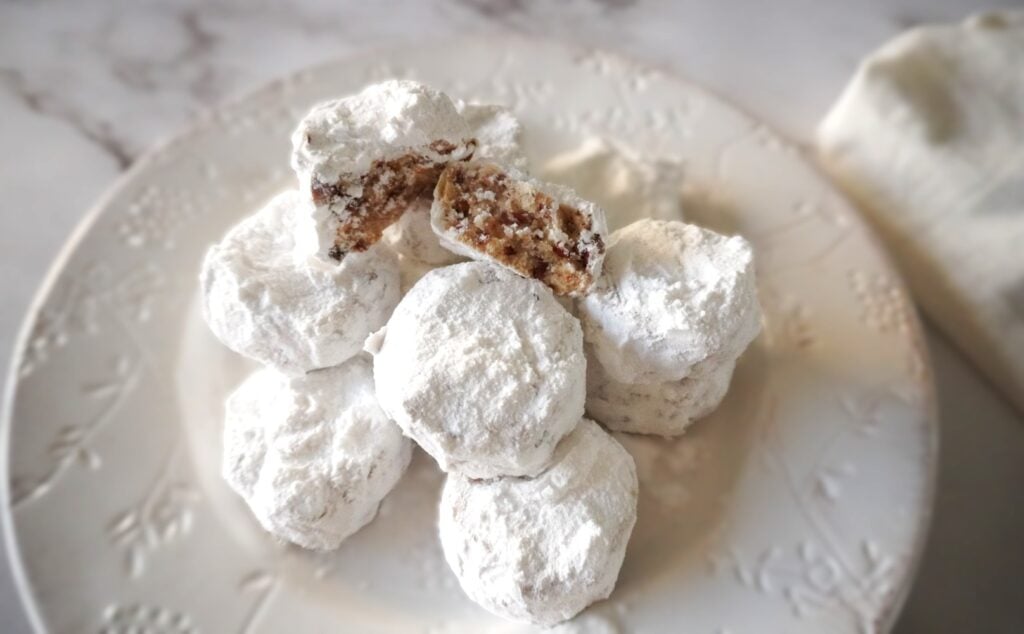
These kourabiedes are light, airy, intensely buttery, and melt in your mouth. No dryness. No heaviness. Just delicate shortbread with toasted almonds and a generous snowfall of powdered sugar. The secret is not exotic ingredients or tricks — it’s time and patience at the mixer. If you’re willing to whip the butter properly, the cookies will do the rest.
Kourabiedes are a traditional Greek Christmas cookie, found on almost every festive table in December. They’re usually prepared days — sometimes weeks — before Christmas and stored in tins, slowly perfuming the house with butter and vanilla.
While melomakarona are bold and honey-soaked, kourabiedes are their elegant counterpart: crumbly, subtle, and rich, relying on texture rather than syrup for impact. The powdered sugar is not decoration — it’s part of their identity.
Tips
- Long whipping incorporates air into the butter, creating a light, melt-in-the-mouth texture
- Powdered sugar dissolves completely, keeping the crumb tender
- Low baking temperature protects the butter and prevents dryness
- Minimal mixing after adding flour avoids gluten development
Tips for Perfect Kourabiedes
- Butter should be soft, not melting
- Do not reduce whipping time
- Do not overbake — cookies should be pale
- Let cookies cool fully before dusting with sugar
Storage
- Store in an airtight container at room temperature for up to 2 weeks
- Flavor and texture actually improve after the first few days.
Q&As
- Why do kourabiedes turn out dry? Kourabiedes turn out dry if the butter is not whipped long enough, too much flour is added, or the cookies are overbaked. They should remain pale.
- How long should I beat the butter for kourabiedes? Beat the butter for at least 20 minutes on high speed to create a light, airy texture.
- Why is powdered sugar used instead of granulated sugar? Powdered sugar dissolves completely into the butter, resulting in a softer, more delicate crumb.
- Can I skip the rum? Yes. The rum can be replaced with brandy or vanilla and does not make the cookies taste alcoholic.
- Why are kourabiedes baked at a low temperature? They are baked at low temperature to prevent browning and keep the cookies tender.
- When should I dust them with powdered sugar? Only after the cookies have cooled completely, otherwise they may break.
- How long do kourabiedes keep? They keep for up to two weeks in an airtight container at room temperature.
Recipe Credit
This recipe is adapted from Stelios Parliaros, maybe Greece’s best pastry chef.
PrintKourabiedes – the Greek Christmas Buttery Almond Shortbread Cookies
Traditional Greek kourabiedes made with butter and toasted almonds, light, crumbly, and dusted with powdered sugar. A classic Christmas cookie that melts in your mouth.
Ingredients
- 300 g unsalted butter, at room temperature
- 110 g powdered sugar
- Seeds from 1 vanilla bean (or 1 tsp pure vanilla extract)
- 1/2 tsp baking powder
- 600 g all-purpose flour
- 150 g almonds
- 20 g dark rum
- extra powdered sugar, for dusting
Instructions
- Whip the butter: Place the butter and powdered sugar in the bowl of a stand mixer. Beat on high speed for at least 20 minutes, until the mixture becomes pale, fluffy, and airy. This step is crucial — the longer you whip, the lighter the cookies will be.
- Toast the almonds. Preheat the oven to 160°C (320°F). Spread the almonds on a baking tray and toast until lightly golden. Let them cool completely, then roughly chop. Keep the oven on.
- Make the dough: Lower the mixer speed and gradually add the flour, baking powder, and vanilla to the whipped butter. Mix just until a soft, homogeneous dough forms.
- Add flavor and texture. Add the rum and mix briefly. Fold in the chopped almonds until evenly distributed.
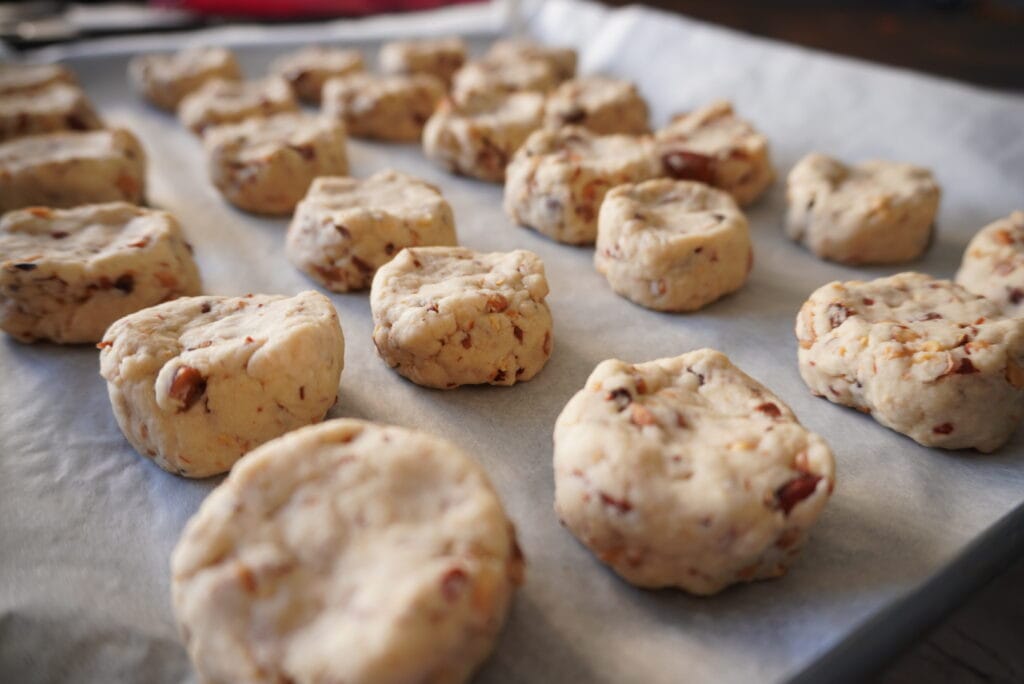
- Shape the cookies. Form small balls of dough, about 15–20 g each.
- Place them on a baking tray lined with parchment paper.
- Gently press your thumb into the center of each cookie to create a small indentation.
- Bake. Bake in the preheated oven at 160°C (320°F) for 20 minutes. The cookies should remain pale — do not wait for browning.
- Cool completely. Remove from the oven and let the cookies cool fully. They are very fragile while warm.
- Dust generously. Once cooled, coat the cookies generously in powdered sugar. Arrange on a serving platter and dust again for a classic finish.