
Τraditional Greek Gemista (Stuffed Tomatoes and Peppers)
There are two kinds of people in this world: those who eat only the rice from the Gemista (stuffed vegetables) — like me — and those who also eat the veggies themselves. And then there’s a third group, the rebels, who add minced meat to the filling. A psychologist could probably tell us what that says about our personalities, but let’s not go there.
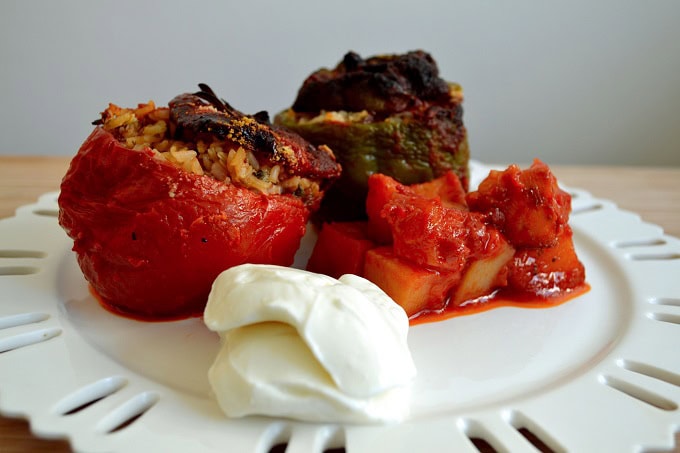
Continuing a nostalgic lineup of mama-style comfort food, after dolmades, we’re making Gemista. A classic summer dish, best enjoyed after the first swim of the season, when the sun has kissed your shoulders and the tomatoes are at their sweetest.
In this version, I use only tomatoes and green peppers, but you can absolutely add eggplants or zucchinis too. Don’t throw away their flesh — blend it and add it to the filling for extra flavor. Traditionally, Gemista are scented with parsley and mint; some people also add dill, but I prefer to skip it. (You do you though.)
Gemista have been part of Greek home cooking since at least the 18th century, inspired by the broader Eastern Mediterranean tradition of stuffed vegetables. In Greece, the dish evolved into a purely summer specialty thanks to the abundance of sweet, sun-ripened tomatoes and peppers. Every region — and every family — adds its own twist: some make them strictly vegetarian, others add meat, but the heart of the recipe remains the same — rice, herbs, olive oil, and the slow, gentle baking that fills the whole house with that unmistakable Greek-summer aroma. If you love authentic meatless Greek dishes, check our full collection of vegetarian Greek recipes here.
Most people serve Gemista with feta — I personally can’t stand feta, and besides, what “most people” can be a little boring, don’t you think?
Tips & Notes
- If using, toast the pine nuts lightly for a nutty, aromatic touch.
- You can make Gemista entirely vegan or add a handful of minced beef to the filling.
- They taste even better the next day — straight from the fridge or at room temperature.
- Choose ripe, firm tomatoes — soft tomatoes collapse in the oven.
- Scoop gently so the walls stay thick enough to hold the filling.
- Grate the tomato flesh instead of chopping it — it melts into the rice for richer flavour.
- Use plenty of herbs (mint + parsley) — Gemista depend heavily on fresh aromatics.
- Let the rice rest in the filling for 10 minutes before stuffing; it absorbs flavour and cooks evenly.
- Don’t overfill — the rice expands; leave a little space at the top.
- Add potatoes between the vegetables — they absorb juices and caramelize beautifully.
- Long, slow baking is key — at least 1 hour 30 minutes for deep flavour and jammy tomatoes.
- Finish with extra olive oil — Ladera need generous olive oil to get that silky texture.
Storage and Reheating
- Fridge: Up to 4–5 days in an airtight container.
- Freezer: Ideally not but you can freeze cooked gemista (without potatoes) for up to 2 months.
- Reheat: Warm gently in the oven at 160°C (320°F). Add a splash of water or olive oil if they look dry.
- Serve warm or room temperature: Like most Ladera, they are delicious at any temperature.
F&A
Can I make gemista without rice? Yes — replace rice with quinoa or bulgur, adjusting liquid as needed.
Can I make gemista with meat?
Of course. Sauté 200–250 g minced beef or pork and mix it into the rice filling.
Why is my rice undercooked?
Either not enough liquid was added, or the vegetables were baked uncovered too early. Always bake covered first, then uncover.
Why did my vegetables collapse?
They were too ripe or too thinly carved. Use firmer vegetables and leave thicker walls.
Should I peel the tomatoes?
No — the peel helps them hold shape during baking
PrintΤraditional Greek Gemista (Stuffed Tomatoes and Peppers)
Traditional Greek gemista — stuffed tomatoes and peppers with rice, herbs and olive oil.
Ingredients
- 4 medium ripe tomatoes
- 4 large green bell peppers
- 10 tbsp Carolina, Arborio, or parboiled rice
- 2 medium onions, grated
- 1/2 bunch parsley, finely chopped
- 1 bunch fresh mint, finely chopped
- 1 carton tomato juice (about 400 ml)
- 1/2 cup pine nuts, toasted until golden (optional)
- 100 g kefalograviera cheese, diced, plus 50 g grated for topping (optional)
- salt and pepper
- 1 tsp sugar
- olive oil
- 4 medium potatoes, cut into wedges
Instructions
- Prepare the potatoes. Place the potatoes in a pot, cover with cold water, add salt, bring to a boil, then simmer for 5-10 minutes until slightly tender but not fully cooked
- Prepare the vegetables. Wash and dry the tomatoes and peppers.
- Cut off the tops (keep them as lids). Remove the seeds and membranes from the peppers. Scoop out the tomato flesh and blend it.
- Preheat the oven to 180°C (350°F).
- Prepare the stuffing. In a large pan, sauté the onions in 2 tbsp olive oil until soft. Add the rice and stir for 1–2 minutes.
- Pour in the blended tomato flesh, half of the tomato juice, the pepper flesh if using, salt, pepper, sugar, and pine nuts – if using. Stir and let it simmer for a few minutes.
- Remove from heat and add the herbs and diced cheese. Stir to combine.
- Fill the tomatoes and peppers about two-thirds full and replace their lids.
- Place them in a baking dish and tuck the potato wedges in between.
- Sprinkle the stuffed vegetables with grated cheese (optional).
- Pour the remaining tomato juice and half a glass of water into the dish and drizzle generously with olive oil.
- Bake for about 1 hour, until the vegetables are soft and lightly caramelized.
- Serve warm or at room temperature with thick Greek yogurt.



Leave a Reply