How to Make the Perfect Greek Moussaka
If you’re wondering which dish most of our guests at CookinAthens want to learn how to cook, let me tell you — it’s moussaka. At CookinAthens, we’ve roasted them, sliced them, layered them, and occasionally even cursed them — but honestly, I wouldn’t trade it for anything.
But honestly, I can’t blame them. Few dishes say “Greek comfort food” quite like moussaka. Rich, fragrant, and layered with flavor, it’s the kind of meal that brings everyone to the table — and keeps them there long after the plates are clean. Moussaka is the best-known Greek dish around the world — more than just a meal, it’s a celebration of Greek culture and tradition. Each bite is a voyage to the heart of the Mediterranean, where fresh ingredients come together to create a dish that’s as comforting as it is elegant.
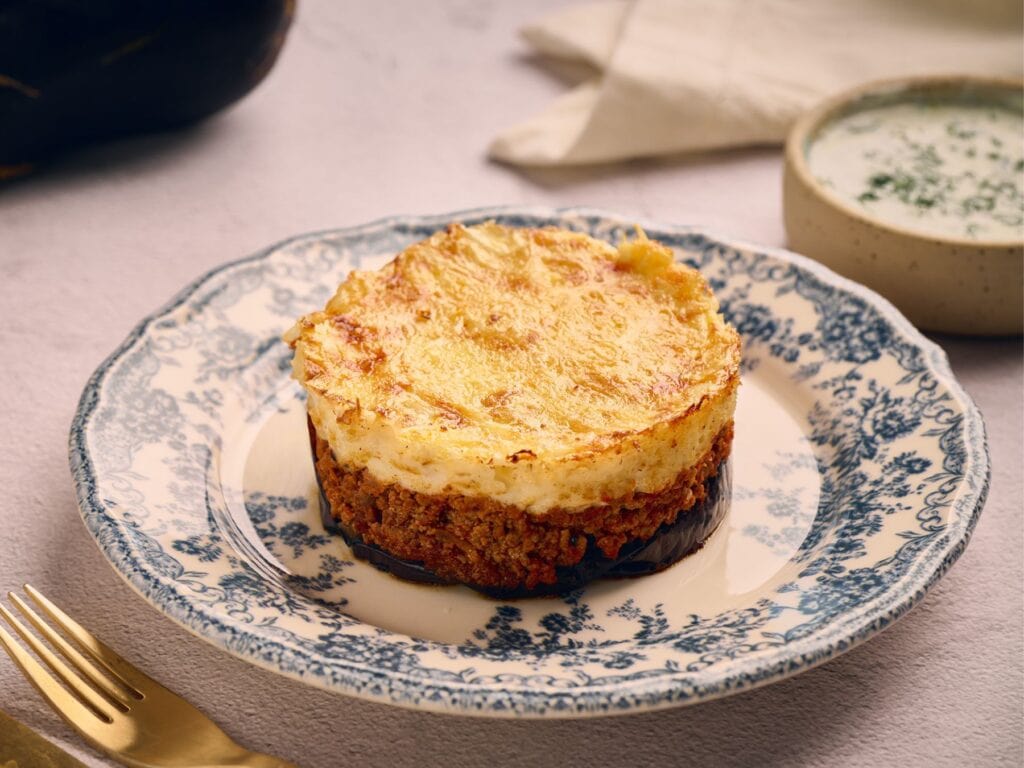
Think of moussaka as Greece’s answer to lasagna: tender roasted eggplants, a warmly spiced meat sauce, and a silky béchamel topping that turns golden in the oven. It’s comfort, elegance, and a little bit of chaos — all baked together in one dish.
Moussaka’s roots lie deep in the culinary heritage of the Eastern Mediterranean — particularly the Middle East and the Balkans. The dish evolved over time and was adopted by various cultures in the region. While its exact origin is still debated, most agree that moussaka as we know it today has strong ties to Greek and Turkish cuisines. The word moussaka comes from the Arabic musaqqa’a, which refers to a dish made with cooked eggplant — a clue to its Middle Eastern ancestry. Over time, it journeyed through cultures, blending influences until it became the Greek icon we know today. Every region — and every cook — has their variation: some use potatoes or zucchini along with the eggplants, others skip the béchamel for a lighter summer version. But one thing is always true: moussaka is comfort layered with patience and love.
The modern Greek version features layers of eggplant, minced meat (always beef — I never understood why so many recipes use lamb!), tomatoes, aromatic spices, and a creamy béchamel sauce. The result? A mouthwatering miracle.
Although moussaka is often considered complicated and time-consuming, I strongly disagree. It really has just three steps:
- Bake the eggplants
- Make the meat sauce
- Make the béchamel
That’s it. I usually prepare a big batch of meat sauce (which also works beautifully for pastitsio or makaronia me kima) and freeze it in portions. Moussaka actually tastes even better the next day — and it freezes wonderfully.
If you like potatoes, you can add a layer of thinly sliced potatoes at the bottom of your dish. Just slice them into 0.5–1 cm rounds, drizzle with olive oil, season with salt and pepper, and pre-bake them for 20–25 minutes until tender. They create a delicious base that helps the moussaka hold its shape and makes each slice even more satisfying.
Tips for the Perfect Moussaka
- Roast, don’t fry the eggplants — it keeps the dish lighter and less greasy.
- Slice the eggplants evenly (1 cm thick) so they cook uniformly.
- Let the meat sauce cool slightly before layering; it helps the moussaka hold its shape.
- The béchamel should be creamy, not too thick — it will set more as it bakes.
- Add nutmeg to the béchamel for a warm, aromatic note.
- Use mizithra, kefalotiri, kefalograviera, or pecorino for that beautiful salty crust on top.
- Let it rest for at least 15 minutes before slicing — it will cut cleanly and serve beautifully.
Notes
- Moussaka keeps beautifully and often tastes even better the next day. Let it cool completely before storing.
- Refrigerate: Place leftovers in an airtight container and refrigerate for up to 3 days.
- Reheat: Reheat gently in the oven at 160°C (320°F) until warmed through. Avoid the microwave — it softens the layers and makes the béchamel rubbery.
- Freeze: Moussaka freezes very well. Cut into portions, wrap tightly, and freeze for up to 3 months. Thaw in the fridge overnight and reheat in the oven.
FAQ
Can I make moussaka ahead of time?
Yes. You can assemble the entire moussaka one day ahead, cover it tightly, and bake it the next day.
Can I use zucchini instead of eggplants?
Yes — slice them the same thickness and roast them before layering.
Can I make it without beef?
Of course. At CookinAthens we make vegeterian and vegan moussaka with lentils or mushrooms instead of meat. You can also use lamb, turkey, pork, or even a plant-based mince.
Can I make it lighter?
Use fat free meat, reduce the olive oil at the eggplants and the meat sauce and use less béchamel or replace part of the milk with vegetable broth. You’ll still get great flavour with fewer calories.
The Perfect Greek Moussaka

Most people, even some Greeks, believe that moussaka is an extremely difficult dish. However moussaka has 3 steps, which all are quite easy and also is even better the next day so you can freeze it really easily. As with most time consuming dishes, mis en place is your friend.
- Prep Time: 40
- Cook Time: 50
- Total Time: 1 hour 30 minutes
- Yield: 4 1x
- Cuisine: Greek
Ingredients
a. The Eggplants
- 4–5 large eggplants, cut into 1 cm rounds
- cup extra virgin olive oil
- salt and pepper
b. The Meat Sauce
- 2 tbsp extra virgin olive oil
- 400 g ground beef
- 1 onion, finely chopped
- 250 g chopped tomato (crushed tomato works perfectly)
- 1 glass of red wine (optional)
- 1 tsp tomato paste
- berries of allspice
- about 5 whole cloves
- 1 tsp granulated sugar
- 1 small stick of cinnamon
- 1 big bay leaf
- salt and pepper
c. The Béchamel Sauce
- 500 ml whole milk
- 50 g butter
- 50 g flour
- ground nutmeg
- salt and pepper, to taste
- 2 egg yolks, lightly beaten (optional)
- grated kefalotiri, pecorino, or parmesan
Instructions
The Eggplants
- Cut the eggplants into 1 cm slices.
- Lay them on a parchment-lined baking tray, drizzle with olive oil, and season with salt and pepper.
- Bake at 180 °C (350 °F) for about 30 minutes, until soft and lightly browned.
The Meat Sauce
- Heat a pot over high heat.
- Add the ground beef and cook until well browned, breaking it up with a spoon.
- Lower the heat, add the olive oil and onion, and sauté for about 5 minutes, until softened.
- Add the wine (if using) and cook 2 minutes, until the alcohol evaporates.
- Stir in the tomato paste, chopped tomato, spices, sugar, salt, and pepper.
- Simmer gently for 30 minutes, until most of the liquid has evaporated.
- Remove from the heat and let cool slightly.
The Béchamel Sauce
- Melt the butter in a saucepan over medium heat.
- Stir in the flour and cook, whisking constantly, for about 5 minutes.
- Add the milk – all at once – while whisking to keep it smooth.
- Continue stirring for another 5 minutes, until thick and creamy.
- Remove from the heat, add nutmeg, salt, and pepper.
- If using egg yolks, whisk them in slowly so they don’t scramble.
- If not using immediately, cover with cling film touching the surface.
Assemble
- Preheat the oven to 180 °C (350 °F).
- Grease a deep baking dish with butter or olive oil and layer half the eggplants on the bottom, slightly overlapping.
- Spread the meat sauce evenly on top, then layer the remaining eggplants.
- Pour the béchamel sauce over the top and spread evenly.
- Sprinkle generously with grated cheese.
- Bake for 40 minutes, until the top is golden and bubbling.
- Remove from the oven and let rest for at least 15 minutes before serving.